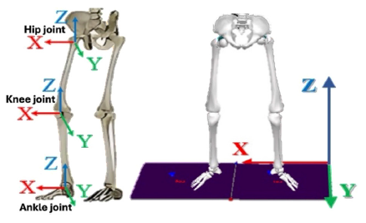
This paper presents a randomized crossover study in which twelve active males compared soft, semi-rigid and rigid 3D-printed polyurethane arch-support insoles during countermovement jumps, using SPM analysis of full-cycle force-plate and eight-camera motion data. Rigid and semi-rigid designs produced significant supra-threshold clusters (p ≤ 0.050) that increased ankle frontal- and transverse-plane kinematics and joint moments during propulsion-flight and landing, while also elevating frontal-plane knee forces, with the rigid insole conferring the greatest ankle stability, demonstrating that arch-support stiffness time-dependently modulates distal-joint biomechanics throughout the CMJ.