
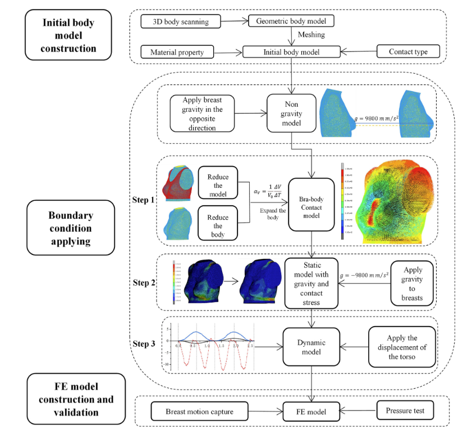
Using a dynamic finite-element breast–bra model and subsequent regression of a 25-run full-factorial design, the study quantified how the local Young’s modulus of five bra regions (cup C, side-front Sf, side-back Sb, band B, under-band U) controls peak contact pressure at four landmarks and 3-D breast range-of-motion (ROM). Pressure was governed mainly by the region covering each sensor and its immediate neighbours (except landmark P3, dominated by U), whereas ROM was driven by Sf, C and U, not by Sb or B. A low-Sb/B, high-Sf/U and moderate-C elasticity layout is therefore recommended to simultaneously minimise pressure and ROM, giving industry a science-based map for tuning zonal stiffness in supportive yet comfortable sports bras.
Xiaofang Liu
Yue Sun
Xiaofen Ji
Kit-lun Yick
Liling Cai